

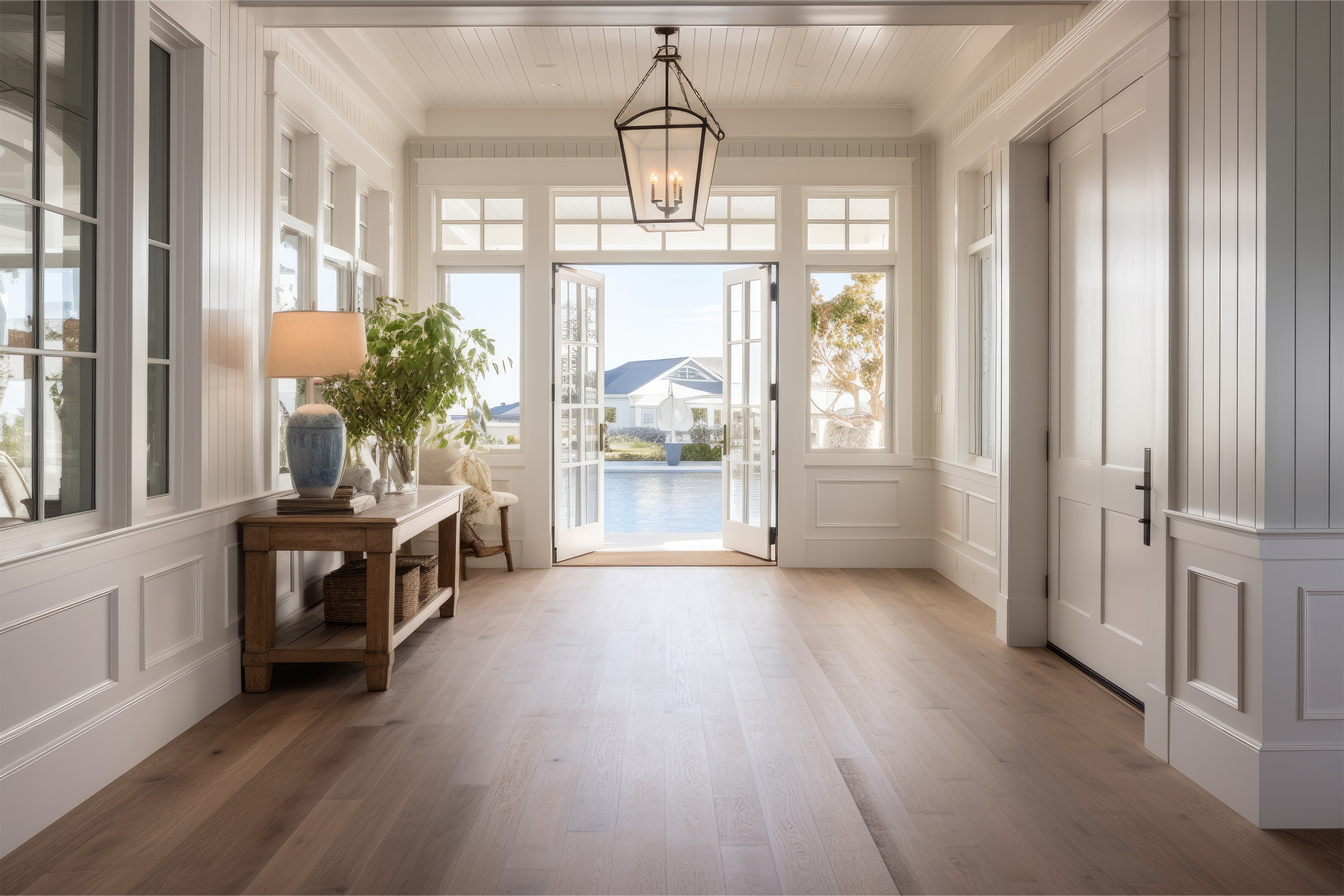
If you live anywhere from Bay St. Louis to Pascagoula, you already know the air here behaves differently. Relative humidity sits above 75% for most of the year, and indoor levels swing hard when the AC cycles or a tropical system pushes inland. Laminate reacts to all of that, which is why some installs still look sharp after ten years while others start lifting at the seams by month eighteen.
At Cozy Comfort Floors, we install and service laminate across all of the Mississippi Gulf Coast, and the floors that fail almost always fail for the same handful of reasons. The good news is that every one of those reasons is visible on the spec sheet before you ever buy. Forget brand names for a minute. The numbers tell you how a floor will behave in July.
Start With the Core, Because That's What Moves
Laminate is built on one of two core types, and this single choice matters more than anything else in our climate. Traditional laminate uses an HDF (high-density fiberboard) core, which is wood fiber under pressure. It performs fine when the edges are properly sealed and the room stays climate-controlled, but it is still wood, and it will swell if moisture finds an unsealed joint. Newer waterproof laminate uses a denser composite core that barely reacts to humidity, which is why we steer most coastal clients toward it for kitchens, entries, and any room next to a slider that sweats in summer.
The number to ask for is core density. Anything above 850 kg/m³ holds its shape through seasonal swings far better than lighter, cheaper boards. A dense core resists the expansion-and-contraction cycle that opens up gaps and pushes seams into peaks, which is the most common coastal failure we're called out to fix. If you're still weighing laminate against tile for a high-moisture room, our breakdown of wood-look tile versus wood-look laminate walks through how each material behaves in Gulfport humidity before you commit.
The AC Rating Tells You How Long the Surface Lasts
AC rating measures abrasion and wear resistance on a scale from AC1 to AC5. For a coastal home, AC3 is the practical floor, AC4 is what we recommend for most families, and AC5 is the right call for beachfront rentals or any home where sand gets tracked across the floor daily. Sand is abrasive, and a low wear layer dulls and scratches faster than people expect down here.
Pair the AC rating with the wear-layer thickness and the surface finish. A matte or wire-brushed finish hides fine sand scratches and footprints far better than a high-gloss surface, which shows every particle the moment the sun comes through the window. In a Gulf Coast home, finish is a performance spec, not just a look.
Edge Sealing and Warranty Language
The edges are where humidity attacks first. Look for boards with wax-sealed or fully sealed edges, because an unsealed joint is an open door for moisture to wick into the core. This is the difference between a floor that shrugs off a spill and one that swells along a seam you can't even see.
Then read the warranty, specifically the exclusions. A genuinely coastal-ready product backs its moisture claims in writing, often guaranteeing the surface against standing water for 24 hours or more. If the warranty buries a humidity exclusion on page four, that tells you exactly how the manufacturer expects the floor to behave in our climate, and it isn't a vote of confidence.
Where Most Coastal Installs Actually Go Wrong
Even a perfectly specced floor fails if the install is rushed. Boxes need to acclimate in the actual room for at least 48 hours with the HVAC running at normal conditions, so the boards reach the temperature and moisture level they'll live at. Skipping acclimation is the single most common cause of peaking and gapping we see in homes built in the last decade.
Expansion gaps are the other failure point. A quarter-inch perimeter gap is the bare minimum, and runs longer than 30 feet need a transition strip to break them up. Without room to move, a humid-season floor lifts at its weakest joint. The right underlayment with a built-in moisture barrier adds another layer of protection over a slab, which matters a great deal in our slab-on-grade coastal homes.
See the Specs Side by Side Before You Buy
Choosing laminate for a Gulf Coast home is a spec decision first and a color decision second. The smartest thing you can do is compare core samples, wear layers, and warranty sheets in person before you fall for a particular plank.
Visit Gulfport, MS to handle the actual cores, feel the difference between finishes, and read the warranties laid out next to each other. We serve all of the Mississippi Gulf Coast and bring the same honest, number-first breakdown to every estimate. Ready to find laminate that genuinely lasts here? Contact us at Cozy Comfort Floors to schedule a free in-home measurement or stop by the showroom for a one-on-one consultation.


